
Cooke County Civil Docket Searches
Start with the court named on any pleading or notice you have. The 235th Judicial District Court sits in Cooke County. It takes on district-level civil cases, title-to-land disputes, divorce and family matters, and similar proceedings. The District Clerk holds those files. The Cooke County Court at Law carries civil, family, probate, guardianship, juvenile, and criminal jurisdiction. Its records go through the County Clerk. Justice courts handle smaller civil matters that fall within their limits.
Search by cause number first, before trying a party name. Once you pull the entry, look closer. Check the court, style, filing date, and status against what you know. You may spot a prefix like CV or PR in generalized Cooke samples. Treat it as a clue only. A prefix alone cannot tell you the full case type.
- Identify the court and record custodian from the most recent case paper.
- Try Texas Online Records or re:SearchTX with Cooke County and court filters.
- Check the county docket hub when the goal is a current hearing setting.
- Search the District Clerk and County Clerk separately if a name returns no result.
- Request a document by cause number, party names, case type, and exact title.
Cooke County Civil Court Split
Civil cases in Cooke County do not all land in one courtroom. The 235th Judicial District Court takes the big ones. Its civil work covers major civil disputes, district family matters, and title-to-land cases. County Court at Law runs a mixed docket. That mix covers county-level civil claims, family work, probate, and guardianship. Small civil claims can go to a justice court instead. And municipal courts play no role as a general civil forum here.
The split also decides which clerk holds the file. District Clerk Marci A. Gilbert keeps the 235th's civil and family records. County Clerk Pam Harrison holds the County Court at Law civil, probate, and guardianship papers. Send a request to the wrong office and it may simply stall. Cooke County's own records instructions warn that departments need not forward misdirected open-records requests. So name the court, not just the case.
| Civil matter | Likely court | Custodian |
|---|---|---|
| Major civil or land-title dispute | 235th Judicial District Court | District Clerk |
| District family case | 235th Judicial District Court | District Clerk |
| County civil, probate, guardianship | County Court at Law | County Clerk |
| Lower-dollar civil claim | Justice court | Issuing JP court |
Civil Dockets: What They Show
The Cooke County Court at Law sample schedules cases in half-hour blocks. Labels include FAMILY LAW, PROVE UP, MOTION TO COMPEL, JURY TRIAL, FINAL PRETRIAL/ANNOUNCEMENT, and STATUS. District dockets follow a case, time, party, and attorney layout. Either way, the docket shows where a case sits on the calendar. It does not prove what the court decided. Only a later signed order does that.
| Cause number | The unique court case identifier; copy every digit and prefix. |
|---|---|
| Case style | The caption naming the parties; use it to reject a false match. |
| Filing or event | A petition, answer, motion, order, service event, or other docket activity. |
| Setting | The date, time, and proceeding type scheduled by the court. |
| Status | An administrative description that may require later entries for context. |
| Judgment or order | The filed document that can establish a ruling or final result. |
Keep "filed," "set," "heard," "ruled," and "disposed" straight in your mind. A motion-to-compel row just means a discovery dispute got scheduled. It says nothing about whether the motion was granted. A prove-up presents evidence in an uncontested matter. The final decree or judgment is still the result you need to obtain.
Cooke County Civil Scheduling
Cooke County local rules lay out a civil path. Knowing it helps you read docket entries. At a scheduling conference, the judge sets discovery deadlines and dates further down the line. Motions still pending can get taken up before the final pretrial conference and announcement. Settlement talks can surface in the entries at any point. So can trial readiness. A jury or nonjury trial comes next. The case then ends with an order or judgment entered on the civil docket.
Civil docket flow: Filing › Service or Appearance › Scheduling Conference › Discovery and Motions › Final Pretrial › Trial or Resolution › Judgment
The rules set targets, not promises. Civil jury cases should be tried within 18 months from appearance. Civil nonjury cases should be tried within 12 months. Complex matters are excepted. Those goals shape how the court plans its Cooke County civil docket. They will not tell you when your case is set. For an actual setting, rely on a case-specific notice and confirmation from the court coordinator.
What Cases Fill the Civil Docket
A Cooke County civil docket covers far more than contract suits. The district route can include title to land. Divorce, other family proceedings, and major disputes fit there too. County Court at Law posts mixed schedules with family, probate, guardianship, and civil events. Justice courts handle matters within the limits Texas law assigns to them.
Some categories deserve extra care. Adoption requests are not ordinary name searches. Guardianship, juvenile, mental-health, and parts of family files can hold restricted content. Probate may be public in part. It can still contain protected data. Use a visible event label to find the right clerk. Never publish personal facts from a sample docket.
| Event | What it suggests | Best record to confirm |
|---|---|---|
| Scheduling conference | Case planning | Scheduling order |
| Motion to compel | Discovery dispute | Motion, response, signed order |
| Prove-up | Uncontested evidence | Final decree or judgment |
| Final pretrial | Trial readiness | Pretrial order and later entry |
| Probate or guardianship | Special county-court matter | County Clerk file and access ruling |
Cooke County Civil Jury Weeks
On the 235th annual calendar, blue marks civil-jury weeks. Green means nonjury weeks, red marks criminal-jury weeks, and white flags courthouse holidays. Think of the color key as a planning tool, nothing more. A blue week does not mean every civil case goes to trial. And no calendar replaces a case-specific notice or a signed setting order.
Use a jury week to get a feel for the court's term. Then find the latest weekly docket or case entry. Write down the cause number, date, time, court, and event label, plus the date you checked the source. If anything conflicts, call the court coordinator. The Cooke County docket hub warns that schedules can change after posting. A later order or notice always beats an old calendar image.
Calendar check: Treat the annual color as context, the weekly docket as a snapshot, and the filed notice or coordinator as the case-specific source.
Hearings on the Civil Docket
Every setting on a Cooke County civil docket tells you what the court plans to do. STATUS means a progress check. MOTION TO COMPILE? No, MOTION TO COMPEL points to a discovery dispute. FINAL PRETRIAL/ANNOUNCEMENT asks whether the sides are ready, and it is not a judgment. JURY TRIAL sets a trial date. A verdict only appears through the entries that follow. Those entries reveal whether a hearing went forward, was reset, or ended in an order.
County Court at Law sets aside walk-in time on Monday and Wednesday, 9:30 to 10:30, for uncontested divorces and agreed name changes. But you must pull the file from the District Clerk before you go. Cooke County local rules describe other uncontested windows along with probate practice. Advance submission of the proposed decree or judgment is expected. The coordinator manages the flow. Call first to confirm the current procedure.
The official Cooke County Court at Law page posts the mixed docket. It also shows how settings are routed.
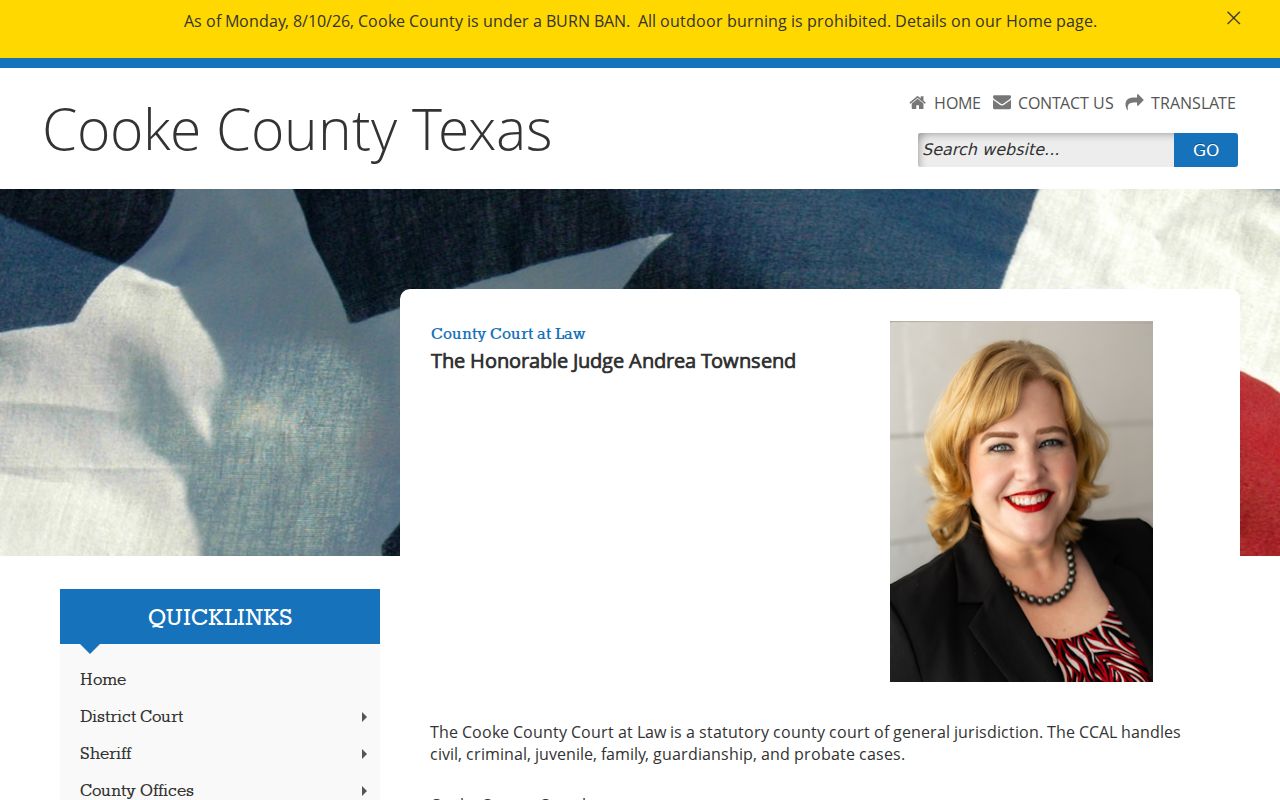
The court page above shows the split in plain view. A county-level civil docket search in Cooke County needs both the County Court at Law schedule and the underlying case file from the right clerk.
Cooke County Civil Copy Costs
Fees for a Cooke County civil case come in layers. A search, a filing fee, a service charge, a plain copy, and a certified copy are each billed separately. The District Clerk's effective-2024 civil schedule sets a $350 fee for a new civil suit. It adds $80 for a subsequent action. Service runs $75 by certified mail from the District Clerk. Sheriff process is $75, publication is $75, plus the publication's own costs. None of that covers simply viewing the docket.
Records work differently. The schedule charges a $5 search and $1 per paper page. Electronic copies run $0.10 per page, with a $1 minimum per document. Certification by the clerk adds $5. The District Clerk request form estimates five to seven business days. It wants payment in advance, and asks for a stamped return envelope if you want copies mailed. Check the current schedule and confirm which clerk holds the file before you send money.
A reporter's record is a separate product again. It is the transcript of what was actually said at the hearing. If the spoken words matter to you, take the reporter route. A docket printout never contains testimony.
Who Can See Civil Dockets
Texas Rule of Civil Procedure 76a presumes court records are open. Sealing is allowed only under the rule's stated test. Even so, access has limits. Adoption, juvenile, and mental-health files, protected family information, financial identifiers, and sealed documents may be restricted or redacted. And a blank image in a portal is not proof the filing never existed.
Public access: Rule of Judicial Administration 12 applies to non-case judicial records, while Texas Rule of Civil Procedure 76a addresses sealing of civil court records.
Start with re:SearchTX or Texas Online Records for whatever electronic material is available. When an image is missing, go to the clerk by email, mail, phone, or in person. Statewide coverage varies by court and integration date. For the full name-and-number workflow, the Cooke County case lookup collects those channels in one place.
Cooke County Civil Record Requests
The District Clerk form splits civil and family requests away from felony records. It wants the cause number, plaintiff, respondent, case type, other identifying facts, and the exact documents you seek. Divorce prompts may ask when the final decree or judgment was signed. Adoption gets its own prompts because access and identification rules differ from an ordinary name search.
Name the item you want: a petition, a signed order, a final judgment, or a docket sheet. Asking for "everything" drives up cost and delay. Mail your request with the required return envelope. For County Court at Law probate or guardianship, go to the County Clerk instead. If you need what was said aloud at a hearing, track down the court reporter. Precise routing saves time, protects private information, and makes a Cooke County civil docket search far more reliable.
Note: a docket entry helps you find a filing, but only the filed document carries its full text and any access restriction.